
Article Summary
- Hidden Doors can provide privacy, security, and a touch of intrigue to various spaces and for various uses.
- Some important factors to consider include the door’s purpose, pass-through space, opening mechanism, blending with the decor, and more.
- Proper planning will ensure both functionality and discretion, allowing you to seamlessly integrate a hidden door into your home.
Secret entrances are more than just novelty items for mansion libraries or spy films. Whether looking for privacy, security, or a cool party trick, a hidden door can offer a functional and elegant solution for modern homes and businesses.
Here are 10 things you should know before purchasing a secret door.
1. Should You Buy a Hidden Door?
If you’ve ever wondered if a secret passageway or entrance is for you, consider these points:
- Security meets discretion: If you’re storing valuables, a concealed door offers more protection than a visible safe. Safes attract attention — hidden doors don’t. They reduce risk by keeping high-value items out of sight. A temporary security lock ensures you control who has access.
- Who benefits the most: Homeowners, collectors, parents, business owners and anyone who values discretion or peace of mind can benefit from a hidden door. You may want to stash family heirlooms, firearms or sensitive documents.

2. What Will You Use the Hidden Door For?
Hidden doors are highly versatile. Look at the following applications to determine what you’ll use yours for:
- Escape: Secret entrances aren’t one-size-fits-all. If you’re planning a security door for emergency exit or home invasion protection, you’ll likely need more reinforcement than you would for simply hiding your wine stash.
- Storage: Consider what you’re storing to assess your space needs. Are you storing valuables or items without a high monetary value? The answers to these questions will help you decide how much security you require.
- Fun: Your use case defines everything — from materials to mechanisms. A custom hidden door for a panic room has different demands than a playful passage to a game room. Decide early on whether you want a distraction, a deterrent or a true fortress.
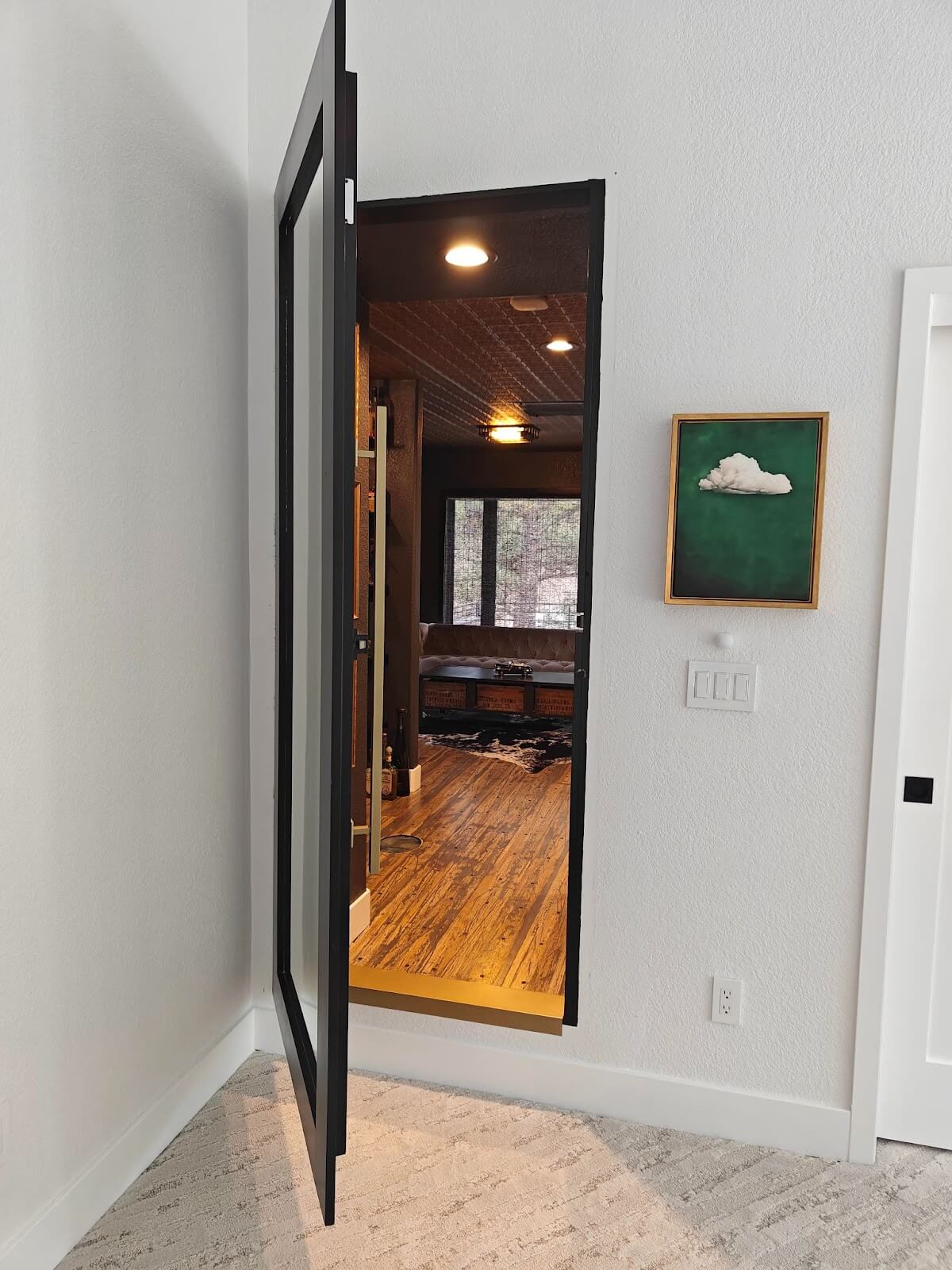
3. Understanding Pass-Through Space and Door Clearance
An entry affects how wide your pass-through opening will be once it’s fitted. Unlike traditional doors, which don’t obstruct the opening much, a secret door can occupy more room.
- It’s not just about the doorsize: The most misunderstood metric for installing a hidden door is clear width – or in other words, the width of the widest object that will fit through the door when it is open. You’ll need to measure the rough opening (the hole in the wall when the door and trim has been removed) to calculate the clear width, not just the existing trim or slab. Clear width affects usability most as it determines how wide an object can pass through.
- Thick doors reduce clearance: For entrance covers like bookcases, expect a significant reduction in walk-through width, potentially up to 12 inches. Planning prevents disappointments. If you want oversized furniture in the secluded alcove, move it inside the space before fitting the closure. The Hidden Door Store can provide spec sheets that show the exact width of the widest object that will fit through an open secret passageway door.
4. Choosing the Right Opening Mechanism
Just like cars, you can choose between manual or automatic. Your choice depends on your goals. Some entryways have to open in a controlled motion to avoid flinging decorations on your shelves across the room.
- Pull-to-open or push-to-open mechanisms: To choose between these options, consider the space availability on either side of the door, leaving a wide berth for opening and closing to avoid any safety hazards.
- Sliding or pivot-style hidden doors: Sliding doors maximize small spaces since they don’t require clearance when opening or closing. However, they can be more costly, require more force to open and close, and the layout of the building has to be compatible.
- Automated or manual opening systems: Automated doors are convenient and ideal for people experiencing limited mobility. However, manual hidden doors are more cost-effective, don’t require electricity, and are usually faster and therefore less tedious to open and close often.
- Hydraulic closers: If you have a heavy door or want a smooth opening sequence, hydraulics are the way to go. These can be configured to open the door when the magic switch is used, or they can also be configured to close the door automatically – a handy feature for in-swing doors that don’t have a handle like in-swing mirrors or panel doors.
- Spring-loaded poppers: Ideal for showing off, with this mechanism, the door will jump forward like in mystery movies, but at a much lower cost than a motorized system or a hydraulic closer.

5. How Will Your Hidden Door Blend In?
When deciding how to install a hidden door and keep it hidden, keep in mind that:
- Design matters: Thickness affects appearance and function. Choose materials and finishes that match your existing decor, or go with something neutral for aesthetic flexibility.
- Camouflage makes or breaks it: A concealed entrance is only as good as its disguise. Consider what would look natural in your space, such as a china cabinet in the dining room, a cue rack in the game room, a linen closet in the laundry area or a full-length mirror in the bathroom. Mirrors or artwork are great for concealing your secret entrance.

6. Is Your Wall Structure Compatible With a Hidden Door?
While secret openings work well on most wall types, you must work within your property limits. Strong walls ensure durability. If you mount a custom steel hidden door on weak walls, the structure may sag or fail.
Consider which hidden door will be most compatible with your wall type.
- Drywall with a two-by-four: These walls are good for lightweight covers but not for heavy security doors.
- Reinforced concrete or brick: This type of wall is strong but expensive to modify, though it can carry most secret entrances.
- Metal framing: This requires “bucking” – an internal wood blocking to anchor the door’s weight.
7. Exploring Different Types of Hidden Doors
Form follows function. These options are all excellent to consider for your secret space:
- Bookcase design: This classic design is highly customizable to fit into your wall, sits flush on the surface or as a freestanding bookcase, and frees up space in the secret alcove.
- Mirror doors: This option is stylish, low-profile and great for smaller spaces.
- Sliding and pocket covers: This style is space-saving but more complex to install and usually more costly.
- High-security doors: Steel-reinforced doors are ideal for panic rooms and safes.
8. In-Swing vs. Out-Swing: Which Is Best for Your Space?
Your mechanism depends on the room dynamics and available space. Some hidden door models come in one swing direction, so plan accordingly.
- In-swing: In-swing keeps doors flush with your wall but eats up space inside your secret room as you can’t keep anything behind the door.
- Out-swing: Out-swing preserves interior space, making it better for tight spaces. However, the camouflage can be less perfect and the clear opening will likely be narrower for any given bookcase width.
9. Concealed Hinges and Latch Mechanisms
How you hang and close the secret door will impact the success of your undisclosed opening. Visible hardware ruins concealment. A sagging cover or visible barrel hinge kills the illusion and may even scratch the finish. Keep these points in mind:
- Use high-end concealed hinges: Soss hinges don’t offer adjustability and tend to sag. Instead, use multi-axis adjustable hinges specially engineered for installing secret doors.
- Latches should match your goals: Do you want magnetic, mechanical or multipoint closures? The right latch can enhance security and stealth.
- Keep your hinges in prime condition: Hinges work hard, and — with so much weight on them — it helps to lubricate them and clean any dust or grime that could damage the mechanism. Tighten screws if the hinges sag.

10. Budgeting for Your Hidden Door
If you want to save, stick to the Hidden Door Store’s offerings. These products are efficient and keep costs down without sacrificing quality. Expect more design and fabrication lead time for a custom door than from a ready-to-install hidden door.
When planning your budget, you should:
- Know your range: A ready-to-install door starts at around $2,000 and goes up to about $5,000. Custom ones start at $10,000 and can cost over $200,000, depending on your criteria and the installation scenario.
- Plan for hidden costs: Your budget should also include shipping at $300 to $500, installation labor — usually an hour or two if the opening is ready — and power wiring for doors with wireless access control systems. You may also need trim removal and wall prep, which is an additional cost.
Frequently Asked Questions
What Is a Hidden Door?
A hidden door is a door that looks like something other than a door when it is in the closed position so it can cover a secret or concealed space. Often, a mirror or bookcase or some variant of those, but it can also blend seamlessly into the surrounding wall or painted surface.
What Materials Are Typically Used for Building a Bookcase Door?
Typical material types include engineered hardwood, hardwood veneers and steel-reinforced frames for security applications.
How Much Does It Cost to Build a Bookcase Door?
Prebuilt options from the Hidden Door Store range from $2,000 to $5,000, while custom hidden door costs can start at around $10,000.
What Are the Key Measurements and Dimensions to Consider When Designing a Bookcase Door?
Always measure the rough opening, not just the trim. Clear width or walk-through space is crucial for usability.
What Type of Hardware Is Required to Install a Bookcase Door?
Precision ball-bearing pivots, concealed adjustable hinges and integrated latch mechanisms are standard.
Where Can I Find Inspiration and Tutorials for Building a Bookcase Door?
Visit the Hidden Door Store’s resources for videos, spec sheets and more FAQs.
Function and Flash
A concealed opening is more than a gimmick — it’s a working piece of furniture and architecture. Whether you’re going for intrigue, privacy or peace of mind, choosing the right product means balancing your needs, budget and space constraints.
If you’re ready to install a hidden door, explore the full collection at Hidden Door Store. For unique builds or advanced security, check out Hidden Door Store and enjoy the magic of a secluded space.