Article Summary
- Inswing and outswing mirror doors offer distinct advantages based on room layout and clearance.
- Threshold vs. thresholdless designs affect durability, alignment and visual concealment.
- Hidden Door Store helps you choose the right configuration to balance aesthetics, accessibility and long-term performance.
Mirror Secret Door: Threshold vs. Thresholdless
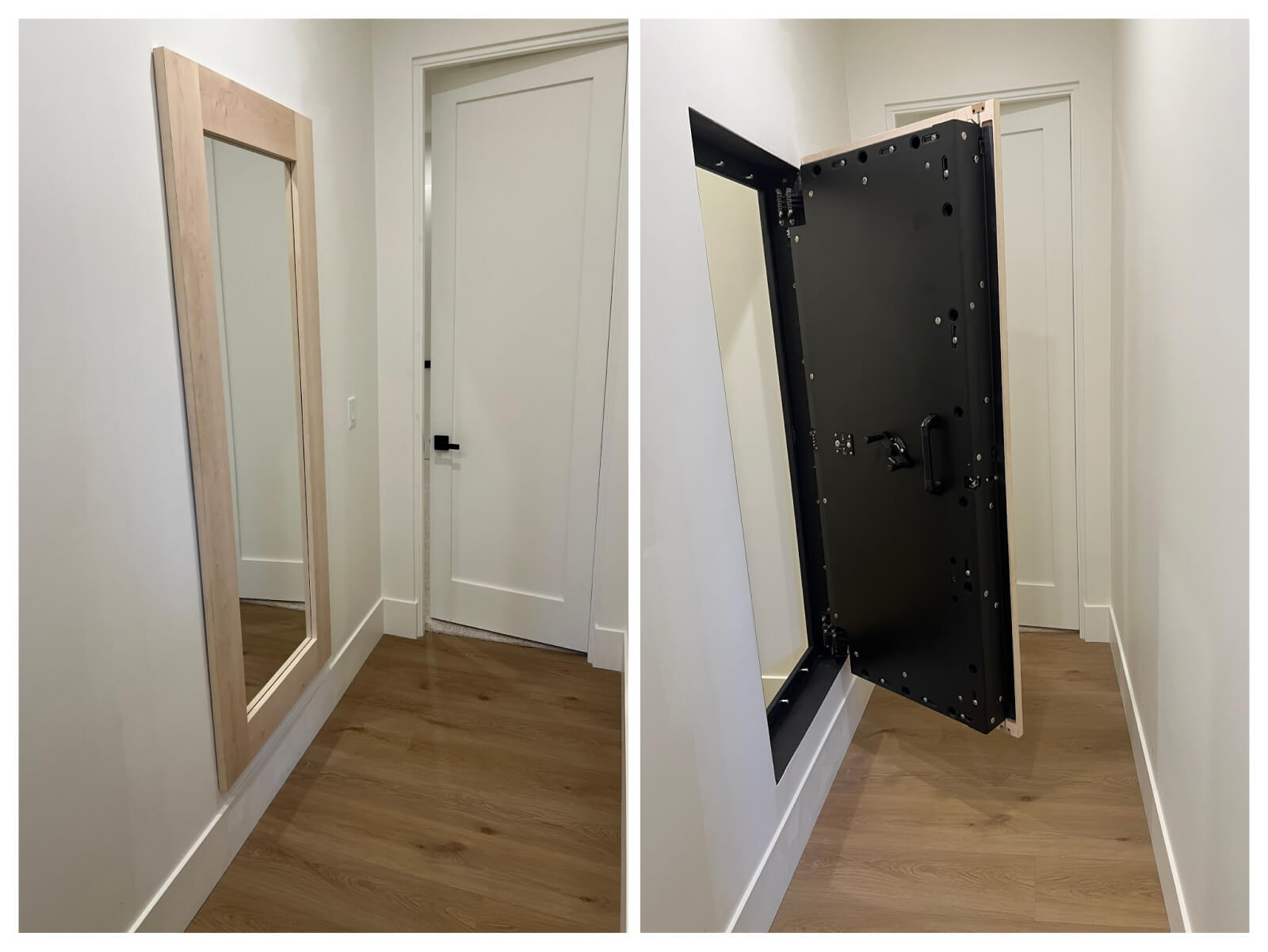
A mirror secret door is a specialized architectural system that conceals an entryway while functioning as a full-height mirror. Unlike a decorative hidden panel, it must perform as a true structural element, supporting significant weight and maintaining precise alignment over time. A properly designed hidden mirror door is indistinguishable from a fixed mirror door when closed, yet operates smoothly and reliably when accessed.
Because mirror doors combine visual deception with mechanical complexity, design decisions must be made early and deliberately. Swing direction, threshold type and structural support all directly affect durability, concealment quality and daily usability.
How Do Secret Mirror Doors Work?
A mirror secret door works through a combination of precise mechanical design and concealed hardware. The starting point is the mirror itself, which is bonded directly to a wooden door slab using strong adhesive. This creates a solid, unified panel rather than a frame holding loose glass, which is both stronger and harder to detect.
A mirror secret door operates through a combination of precise mechanical design and concealed hardware. The mirror itself is bonded securely to a wooden door slab using strong adhesive, creating a solid, durable panel that won’t break during normal use. This allows for fully custom sizes to fit unique wall spaces while maintaining safety and structural integrity.
Many modern hidden mirror doors feature a magnetic switch option and an electronic sensor embedded in the woodwork, so it remains completely concealed. When a magnet is brought near the sensor, the system detects its presence and triggers a switch that opens the door. This creates a seamless, touch-free way to access a mirror door hidden room, enhancing security and the illusion of a static mirror.
What Are the Mirror Secret Door Options?
There are two primary operational configurations for a mirror hidden door: inswing and outswing. Each configuration affects how the door interacts with the visible space and the concealed room.
Inswing Mirror Secret Door
An inswing mirror secret door opens inward into the hidden space. This option is preferred in high-visibility areas because it maintains the mirror wall’s clean appearance when the door is closed. All movement occurs inside the concealed room, which helps keep the illusion of a stationary mirror. Inswing doors also reduce the risk of collision with furniture, foot traffic or nearby architectural features. Inswing mirror doors have self-closing hinges, making it easier to exit the secret room.
Inswing systems require adequate clearance within the hidden space to allow the door to open fully without obstruction. This makes them ideal for walk-in closets, private offices, dressing rooms and secure spaces that are intentionally designed around the door’s movement. In many cases, inswing hidden mirror doors can be assembled by handy homeowners with strong DIY skills.
Outswing Mirror Door
An outswing mirror door opens outward into the visible room. This configuration is commonly used when the concealed space is compact or when interior clearance is limited by built-in storage, safes or mechanical equipment. Outswing designs are also useful in retrofit projects where modifying the hidden room is impractical.
While outswing doors can remain discreet, they require careful planning to avoid disrupting furniture layouts or circulation paths. Proper hinge and pivot placement is critical to ensure smooth operation and to protect the mirror surface from stress during repeated use. You can only choose your threshold type if you have an outswing mirror door.
The Difference Between Threshold and Thresholdless Mirror Doors
The choice between a threshold mirror secret door and a thresholdless mirror door determines how the door interacts with the floor and how weight and alignment are managed over time.
Threshold Mirror Secret Door
A threshold-based system includes a defined transition at the base of the doorway. It serves as a structural reference point, helping stabilize the door and maintain consistent alignment. It can also assist in distributing weight, reducing strain on hinges and pivot hardware.
The benefits of a threshold mirror secret door include:
- Providing additional structural stability for heavy mirror panels.
- Helping maintain long-term alignment and reducing the risk of sagging.
- Distributing the load more evenly across hinges or pivot hardware.
- Improving sound isolation and minimizing light bleed between rooms.
- Offering greater tolerance for minor floor movement or settling.
- Incorporating into high-use applications and security-focused spaces.
Thresholdless Mirror Door
A thresholdless system eliminates raised-floor transitions, allowing continuous flooring between spaces. This approach places all structural responsibility on the door frame and hardware, requiring precise leveling and installation. While visually superior in many cases, thresholdless designs offer less tolerance for floor movement or structural settling.
The benefits of a thresholdless mirror door include:
- Creating a seamless, uninterrupted floor for a cleaner visual appearance.
- Enhancing the illusion of a hidden door behind a mirror.
- Supporting accessibility by eliminating raised transitions.
- Complementing modern and minimalist interior designs.
- Allowing flooring to flow continuously between spaces.
- Delivering the highest level of visual concealment when properly installed.
Choosing the Perfect Mirror Secret Door
Choosing the correct mirror door configuration requires balancing aesthetic goals with functional demands. Spaces that experience frequent use or require enhanced privacy typically benefit from the added stability a threshold provides. Areas focused on visual impact and seamless design may justify the tighter tolerances necessary for a thresholdless installation.
Swing direction should be determined by the room layout, clearance requirements and how the hidden room’s mirror door will be accessed. Inswing designs generally offer better concealment, while outswing configurations are often dictated by space constraints rather than preference.
Creative and Unexpected Uses for Mirror Secret Doors
Mirror secret doors show up in a wider range of settings than most people expect. Commercial installations are common: a financial services company used one to conceal a staff game room with a bar and air hockey table, keeping the space out of sight from clients without closing it off. Escape rooms are another natural fit, since the operational magic of a mirror door that opens with a hidden trigger is already part of the experience guests are paying for.
Rental properties are a recurring use case as well. Owners with a mother-in-law suite or a second unit want a division between the main living space and the rental, but do not want a visible door advertising the connection. A mirror secret door solves this cleanly without altering the visual character of either space. One international project involved a pair of back-to-back mirror doors installed between two units in a jurisdiction where combining apartments was restricted. The doors had to be convincing enough that an inspector actively looking for a connection could not open or identify them. Both passed.
What to Expect After Living With a Mirror Secret Door
Threshold wear is the most predictable maintenance item. If people step on the threshold repeatedly over years, scuff marks will eventually show. This is one practical reason some owners prefer the thresholdless design: there is simply nothing at floor level to mark up.
Fingerprints are the other consideration that surprises inswing door owners. Because inswing doors are opened by pushing on the glass itself, the surface collects prints. The practical workaround is to open with a knuckle rather than a fingertip, or use a corner of clothing. Before leaving for an extended period, it is worth wiping the glass down if the door’s location is a concern from a security standpoint.
Inswing doors also require a hydraulic self-closer, since the door needs to pull shut behind someone exiting the hidden room. There is no handle on the outside to grab. The closer means the door resists being pushed open and you will hear a click when the latch releases but need to push against slight resistance to open it. Inswing configurations are not available with a door popper for this reason.
Common DIY Mistakes With Mirror Secret Doors
The most common DIY failure is exposed barrel hinges. It happens more often than it should: the hinge barrels are simply visible from the front, immediately revealing the door for what it is. One step better is using cabinet door hinges, since they are technically concealed. But cabinet hinges are not engineered for a full-height, heavy mirror panel. They require individual adjustment across every hinge, fall out of alignment quickly, and the upper hinges cannot manage the tension load no matter how many are used. The result is a door that sags within months.
The other common issue is proportion. Without CAD design, gaps appear at the edges, light bleeds through, or the door looks subtly off even when closed. These details are difficult to get right by eye on a first build. A specialist brings thousands of iterations of refinement that have eliminated the small errors that make a mirror door look like a mirror door rather than a mirror.
A mirror secret door is a sophisticated architectural solution that demands careful planning and expert execution. Whether selecting an inswing or outswing configuration, a threshold mirror secret door for added durability or a thresholdless mirror door for seamless integration, the choice carries structural and visual implications. Explore the full range of hidden mirror doors at Hidden Door Store and find the perfect mirror secret door to elevate your space today.
FAQs
Can the door be secret from both sides?
If you have a double-sided door, you’ll have trouble making it perfect on both sides. However, you can do two doors back-to-back.
How long does the installation usually take?
If the door opening is the correct size, installation should only take an hour or two.
Will the glass break easily?
The glass mirror is glued securely to the door to enhance durability and prevent breakage.