
Article Summary
- The Hidden Door Store employs meticulous quality control (QC).
- This process consists of seven steps, from door assembly to packaging.
- Painstaking QC has given HDS the immense confidence to provide a lengthy warranty and helped grow their clientele.
Testing Hidden Doors Before Shipment: How & Why A QC Process Makes the Difference
Strict quality control (QC) separates good hidden doors from bad ones. Even the most convincing disguises on paper could fail in reality if they’re not tested thoroughly enough before shipment, which can jeopardize your safety when discovered too late. The Hidden Door Store has perfected a QC process to ensure every product shipped out measures up.
What Is the Testing Process of Hidden Doors?
The Hidden Door Store has been in business for more than 20 years — a feat impossible to achieve without consistently delivering flawless secret doors to customers. The stringent interior hidden door quality control is one of their secrets to success, and here’s how it works.
Step 1: Assembled Doors Preinstalled for Quality Inspection
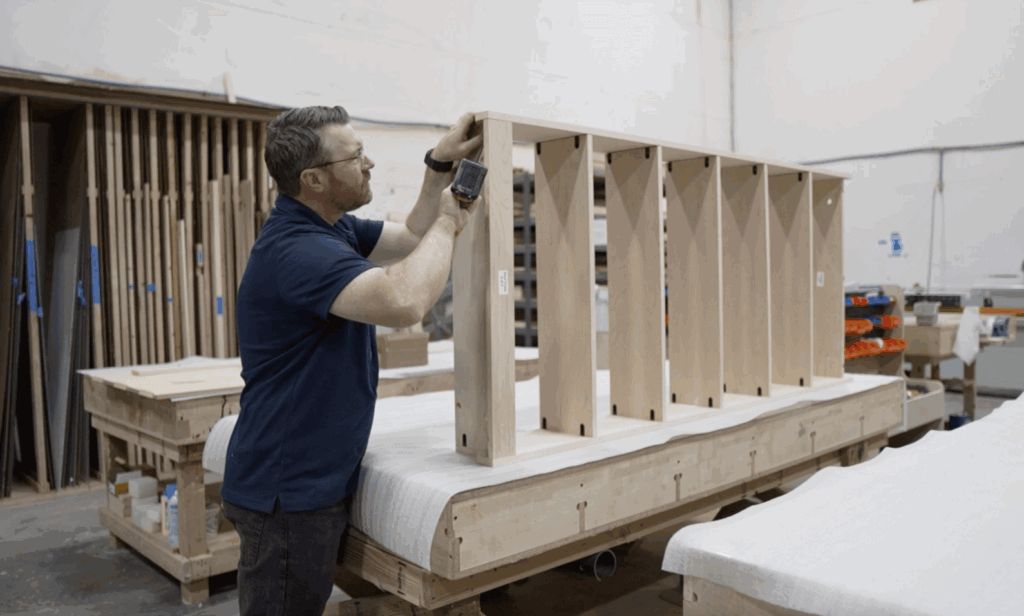
The team fully assembles and installs every bookcase, mirror, linen closet, shoe rack, hutch, wine rack, panel and bookshelf door into a test frame. The workshop simulates real-world conditions to preview how each unit looks and operates.
This step enables them to spot even minor fit or operation issues before packaging the product for shipping. Discovering imperfections at this early stage allows the experts to address the problem permanently and ensure the door is ready to install without unexpected adjustments when it arrives.
Step 2: Alignment & Fit
The Hidden Door Store verifies that the unit sits plumb, square and flush in the frame. This step is particularly important when testing a security door like a hidden vault mirror door, which should remain incognito and avoid detection during high-stakes situations like home invasions. Adjusting the unit accordingly to ensure perfect reveals and smooth clearances is vital for concealment.
They perform the penny test — an assessment no other hidden door company does — to catch inaccurate measurements that can cause light leakage. This test determines whether the visible seams measure 1/16th of an inch — the thickness of a penny. A door can only move on to the next step of the QC process when its gap across the floor is no greater than the thickness of two coins stacked flat. They’ll send customers photographs to illustrate how minimal the gap is.
The test jig is plumb and straight, so it accurately exposes defective units. However, even a perfectly made hidden bookshelf door may look and operate poorly if your floor is uneven due to foundation damage or your wall is badly bowed. Beforehand, you must fix any structural issues that may prevent the hidden bookcase or mirror door from fitting tightly to the opening to ensure effective camouflage.
Step 3: Smooth Operation
HDS tests their secret doors for effortless opening and closing with no rubbing and sticking. The team operates each unit multiple times to confirm smooth operation. This step helps reveal any bowing or twisting in the wood, which can indicate the lumber didn’t dry evenly.
They also evaluate the emergency entrance mechanism — a standard feature of the hidden doors. Every mirror or bookcase door comes with an alternative ingress method, which will help you get into your concealed room in the unlikely event of a failure.
Step 4: Lock & Latch Functionality
The Hidden Door Store confirms that all locking mechanisms, magnetic catches and hidden releases work properly. Ensuring that these pieces of hardware operate and are not rickety guarantees the door’s long-term reliability.
Step 5: Finish & Aesthetic Inspection
The team inspects all visible surfaces for scratches, blemishes or finish inconsistencies. These defects can compromise the concealment of the secret recess, room or passageway.
Step 6: Weight & Balance Test
Every preassembled product is tested for proper swing and support, so it doesn’t sag or bind over time. A drooping door renders seams more visible and scrapes the floor, drawing attention to itself.
Many competitors often fail in this department. Invisible hinges can’t support the weight and movement of full-size bookcase doors. Products equipped with such hardware are prone to alignment problems and sagging. Using a non-marking caster does not help either, as it leads to uneven wear and drag.
Step 7: Packaging Integrity Check
The Hidden Door Store puts considerable thought into packaging to ensure all of its prehung products can withstand the rigors of shipping. They use multiple layers of protective material to secure every hidden bookcase or secret mirror door and frame.
The team wraps the cargo with plastic similar to Saran Wrap to prevent anything else from touching the wood surface, especially when it’s finished. Then, it’s covered with soft, velvety foam that’s as thick as cardboard and wrapped a second time.
Afterward, the product — along with a special tool for replacing the AA batteries that power the magnetic triggers for about two years — is placed in a heavy-duty crate. The crate’s shape and handle replacement are customized to reduce the risk of being dropped.
Conventional foam is inserted in the crevices, keeping it as snug as a bug in a rug. The crew adds little pyramids to the top of the freight to discourage anyone from placing anything on the crate. They palletize the whole thing to move it safely using a forklift.
Freight companies have come to evaluate the packaging practices to reduce their exposure to liability for cargo damage — especially now that limits have increased — by ensuring that everything is done correctly. The Hidden Door Store’s techniques for heavily reinforcing crates have blown them away.
Hidden Door Store uses ShockWatch and Tip N Tell, which detect and report when the crate has been dropped or tilted at any point during its journey, keeping the parties who handle them honest. They also pay extra to ensure the trucks that carry out products have a liftgate, which eases loading and unloading and reduces the risk of damage.
While every hidden door kit is shipped as a flatpack, the team makes every effort to keep the unassembled products safe. The 100% successful shipping means the products are never damaged during transit.
Why The Hidden Door Store’s QC Process Sets Them Apart
The Hidden Door Store doesn’t take “assembly line” shortcuts. They build and test every product by hand. The simulated preinstallation process ensures you can set up your hidden mirror door at home seamlessly — no costly, frustrating surprises on install day.
The team guarantees the doors to meet their high standards for craftsmanship and the company’s 10-year no-nonsense warranty reflects their confidence in its products.
Customer Confidence
The Hidden Door Store has enjoyed significant repeat business over the years. Many of their customers continue to buy doors for their other houses and refer their friends.
Clientele has organically grown because other hidden door companies often fail to meet expectations. Many competitors’ customers come to HDS to buy new secret mirror or bookcase doors and discover how superior the team’s products are in every way.
The Hidden Door Store’s QC Process Inspires Confidence
Learn more about the advantages from one of Hidden Door Store’s secret door specialists. Fill out this form to ask questions about specific products and talk about your needs.