
Article Summary
- A burglar-proof door is only as strong as its weakest component, so the slab, frame, hinges, hardware and installation must work as a complete security system.
- Forced-entry resistance and ballistic protection address different threats. A bullet-resistant door isn’t automatically difficult to physically breach.
- Hidden Door Store offers high-security doors for homes that combine reinforced construction with residential finishes, including options designed to blend into the surrounding architecture.
A door can look sturdy and have a heavy-duty deadbolt, but still provide an intruder with a straightforward path inside. That’s because building doors that are burglar-proof require more than strengthening the parts you see.
Access safety relies on the slab, frame, jamb, hinges, locks, fasteners and surrounding structure. If the hinges fail during an attack, an exceptionally strong door slab may offer little resistance. Understanding potential failure points can help you identify the most secure type of door for your home and the threats you want it to resist.
What Does Burglar-Proof Actually Mean?
No residential door is 100% burglar-proof under every possible attack. A more useful measure is how long the complete door system can resist defined methods of forced entry.
The U.S. Department of State uses forced-entry standards that evaluate how long a barrier can withstand attacks performed under specific conditions. The ratings usually track entry within five, 15 and 60 minute benchmarks. That may sound short, but the test simulates trained attackers actively working to breach the door.
A rating describes resistance under controlled attack conditions, rather than suggesting that an ordinary intruder will automatically defeat the door when the rated time expires. That distinction matters when evaluating forced-entry resistant doors.
Determined attackers don’t have to break through the slab’s center. They can target whichever part appears weakest, including the lock, strike plate, jamb, hinges, frame, glazing or mounting points. The best question is not whether the door is strong, but rather whether the entire structure is resilient.
It’s Not Just About Being Kick-Proof
A door that withstands a hard kick has passed only one security test. Real-world attacks may place pressure on several components. Someone may attack locking points, press a pry bar against the frame, compromise exposed hinges or target glass near the lock. Poorly secured fasteners and mounting points can also undermine otherwise robust materials.
Effective reinforced security doors address these vulnerabilities. Multiple protective layers mean there is no single point of failure.
The frame and jamb must withstand the forces transferred from the door upon impact. Hinges need to support the door’s weight while resisting manipulation. Locks and access-control hardware need secure mounting points. The way the complete assembly attaches to the surrounding structure also matters. This whole-system approach distinguishes genuinely secure exterior doors from conventional doors that have merely had an upgraded lock or a thicker slab.
What Are the Hardest Doors to Break Into?
Reinforced steel is one of the primary materials used for high-security doors because it can provide substantially greater resistance to physical attacks than conventional residential construction. However, steel alone doesn’t determine how difficult a door is to breach.
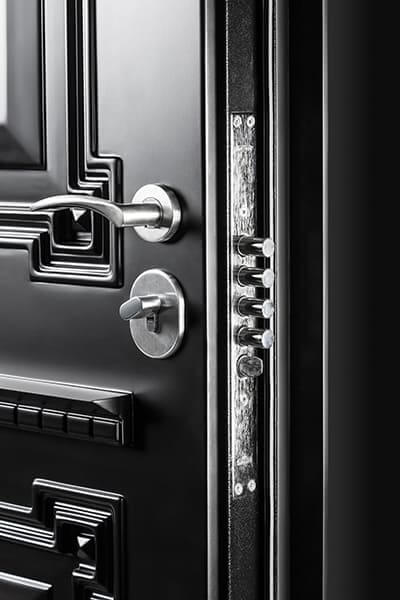
The strongest designs combine the door slab with a reinforced frame, robust hinges, multiple locking points and appropriately engineered hardware. Purpose-built security systems take this concept further. The Hidden Door Store’s Embassy Series door is designed as a vault-style security door that resembles a conventional residential door.
For applications requiring greater structural protection, the Fortress Series uses thicker steel and a heavier-duty construction.The distinction is important when comparing the hardest doors to break into. A conventional door with stronger hardware isn’t necessarily equivalent to an engineered security assembly. Performance depends on how the slab, frame, locking system and various parts work together with the installation to withstand an attack.
Forced-Entry Resistance vs. Ballistic Protection
Forced-entry resistance and ballistic protection solve two different security challenges. One deals with mechanical force while the other involves dynamic energy, and each requires unique engineering and materials to delay physical breach attempts or resist projectile impact.
The mechanical force of a physical assault, such as doors being kicked or hammered with an axe, requires a design that focuses on preventing or delaying someone attempting to breach the opening. Ballistic protection must deter projectiles, such as bullets. One form of protection does not necessarily work for both types of threats.
Home security doors could incorporate ballistic material while having frames, hinges or locking systems that offer limited resistance to physical attack. Conversely, a highly robust break-in-proof door design could resist prolonged physical attacks without including ballistic protection.
Hidden Door Store treats these requirements separately before combining them where appropriate. For example, the Fortress Series can add ballistic protection to a heavier-duty security platform, with UL Level 3 for handguns or UL Level 5 for rifles. Homeowners considering ballistic-strength doors can also compare different ballistic protection levels based on the threats they need the door to address.
The practical priority is defining the threat first. If forced entry is your primary concern, start with the structural resistance of the complete door system. Ballistic protection can then serve as an additional layer when your security needs warrant it. Most burglars are likely armed with handguns, so a UL Level 3 should be sufficient for residential purposes. It protects against multiple shots from small to high-caliber handguns.
Can a High-Security Door Still Look Like a Normal Door?
High-security doors are often designed to look like normal doors. Concealing their capabilities is part of the strategy. A conventional-looking shield door can look like the other doors in your home. Depending on the configuration, subtle details such as larger barrel hinges or visible access-control hardware may indicate what’s behind the finish. Access controls can also be positioned remotely when a more discreet appearance is important.
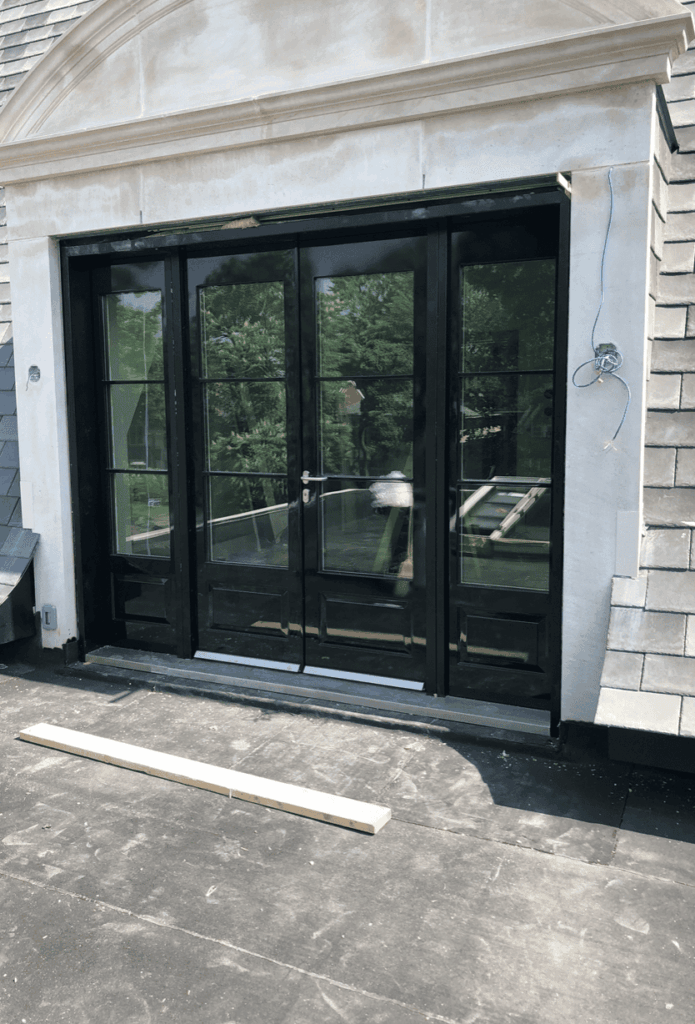
When closed, these burglar-resistant doors can look remarkably similar to ordinary residential doors. When open, their thicker construction, steel frame and locking pins are more apparent. Wood cladding, premium hardwood finishes and millimeter-precise fitment can soften those visual cues so the entrance still feels like part of a home rather than the entrance to a vault.Secret doors take concealment another step by obscuring the entrance itself. Hidden Door Store’s high-security products demonstrate how security engineering coexists with residential design rather than visually dominating it.
Build Security Around the Entire Opening
The hardest door to break into isn’t simply the one with the thickest slab or biggest lock. Effective security comes from engineering the entire opening so that an attacker has no easy component to target. That means considering the slab, frame, jamb, hinges, locks, mounting points and surrounding structure together, then adding specialized protection based on the threats relevant to your home.
Hidden Door Store has pioneered high-quality, precision-engineered hidden doors since 2004, with systems built in its Arizona workshop rather than relying on mass-produced overseas alternatives. Explore its high-security door options to compare configurations designed to combine concealment, residential aesthetics and forced-entry resistance.